What is Picross online?
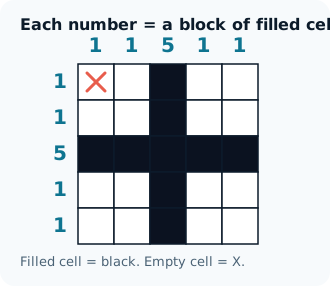
Picross is a logic puzzle drawn on a square grid. Along the left side and across the top, each row and column lists numbers — for example “3 1”. Every number is a run of filled cells; runs appear in the order listed; and two runs on the same line must be separated by at least one empty cell. Nothing about the board is random: on a well-made puzzle every cell can be worked out by deduction, and the finished grid forms a small picture, usually pixel art.
The name reached most English-speaking players through Nintendo’s Picross games, which is why the word is still what people type. The puzzle itself goes back further and travels under several names — Nonogram, Hanjie, Griddlers, Japanese crossword, Paint by Numbers. The rules don’t change with the name. If you want the full naming history, our guide on the history of nonograms covers where it started and how it spread.
Playing Picross online has one practical advantage over a cartridge or a puzzle book: the board can check your work. Here, a completed line is marked, your progress is tracked, and a filled cell that breaks a clue is flagged immediately — exactly the feedback you need while you’re still learning to read the numbers.
How to play Picross online — the rules in four steps
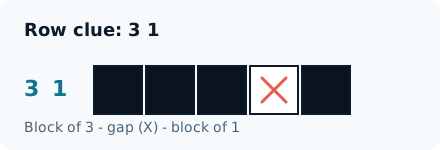
- Read each clue as runs of filled cells, in order — left to right for rows, top to bottom for columns.
- Fill only what the clues force. A well-made board never needs a guess.
- Leave at least one empty cell between two runs on the same line.
- Mark cells you know are empty with X. This isn’t busywork — it’s how you stop yourself repainting a cell you already proved blank.
Controls on desktop: click or drag to fill a run; right-click for X, or switch the toolbar to Mark X. Ctrl+Z undoes, Ctrl+Y redoes. Auto fills the remaining empties once a line is solved. Hint reveals one cell that follows from the clues — useful when you’re stuck, but a run finished with hints doesn’t count for the local Top 5.
Controls on mobile: tap to fill, long-press to mark X, pinch to zoom on larger grids.
Want the slower walkthrough with a worked 5×5 example? Read how to play Nonogram — same board, same controls.
Pick the size that fits your break
Grid size, not the difficulty label, decides how long a puzzle takes.
- 5×5 — one or two minutes. The smallest grid where the clue rules still bite; good for a first win.
- 10×10 — five to ten minutes. Long enough that you’ll need a second pass over the rows.
- 15×15 — fifteen to thirty minutes. Pictures become recognizable.
- 20×20 — forty-five minutes and up. This is where row and column logic has to be combined; expect to scroll on a laptop.
- 25×25 to 45×45 — multi-session territory. Use the zoom control and let Auto carry the easy lines.
Every linked board is free and unique-solution. Browse the full catalog on all sizes & difficulty. Daily sits at 10×10 or larger and steps up as you clear more of them.
Picross online vs Nonogram, Hanjie and Griddlers
Same puzzle, different labels. Picross is the name Nintendo gave its version of the puzzle, and it stuck in English; Nonogram is the general international name you’ll see in books and on most puzzle sites; Hanjie and Griddlers turn up in print collections. The clues, the gap rule, and the finished picture are identical in all of them.
Because Picross is a trademark, this site uses Nonogram as the generic name in its navigation and guides, and keeps this page for players who search the brand name. Looking for a specific Nintendo release? You want an official Picross product — this is a free browser puzzle, not a Nintendo title. Full naming notes: Nonogram vs Picross.
Four techniques that solve most grids without guessing
- Count the whole line. If a clue equals the line length — “5” on a five-cell row — every cell is filled. A clue of “0” means the line is entirely empty. These two cases crack the border of most puzzles.
- Use the overlap rule. For “3” on a five-cell line, the middle cell must be filled no matter how you slide the block. Anything forced by every possible position is safe to paint.
- Work the edges inward. Short lines at the border resolve first; each cell you settle shortens the lines crossing it.
- Mark X early. Every X is information — it shortens the neighbouring lines and turns vague clues into forced ones.
If a line refuses to resolve, leave it and come back once the crossing lines have filled in. On a verified board, a guess is a wasted move, not a strategy. More walkthroughs: how to solve Nonograms.
Picross Online FAQ
Where can I play Picross online?
Right here — the board on this page is live. No install, no account, and it runs on desktop, tablet and phone.
Where can I find free Picross puzzles?
This site. Free boards from 5×5 to 45×45, a new Daily puzzle every day, and printable sheets if you’d rather solve on paper.
What are Picross puzzles called?
Picross (a Nintendo trademark), Nonogram, Hanjie, Griddlers, Japanese crossword, picture cross and paint by numbers all name the same puzzle type.
What is the best website for online puzzles?
Judge any Picross site by four things: whether its puzzles are verified to have a single solution, whether you can pick a size, whether it works without an account, and whether it stays fast on a phone. Those are the standards we build to.
Is Picross the same as Nonogram?
Yes for the rules — same clues, same gap rule, same picture at the end. Picross is a trademark; Nonogram is the generic name.
Do I need an account?
No. Times, streaks and local rankings stay in your browser’s storage.
Is this Nintendo Picross?
No. This is a free browser puzzle of the same type. We don’t sell or host official Nintendo titles.
Is there a daily Picross-style puzzle?
Yes — one shared unique-solution board per US Eastern calendar day on Daily.
Can I print Picross puzzles instead?
Yes — Printable Nonograms generates a sheet you can solve offline.
Does it work on a phone?
Yes. Tap to fill, long-press for X, pinch to zoom; the layout is built for a single thumb even on large grids.